Investing in New Mexico becomes much more interesting once you stop treating the state as a smaller copy of Texas, Arizona or Colorado.
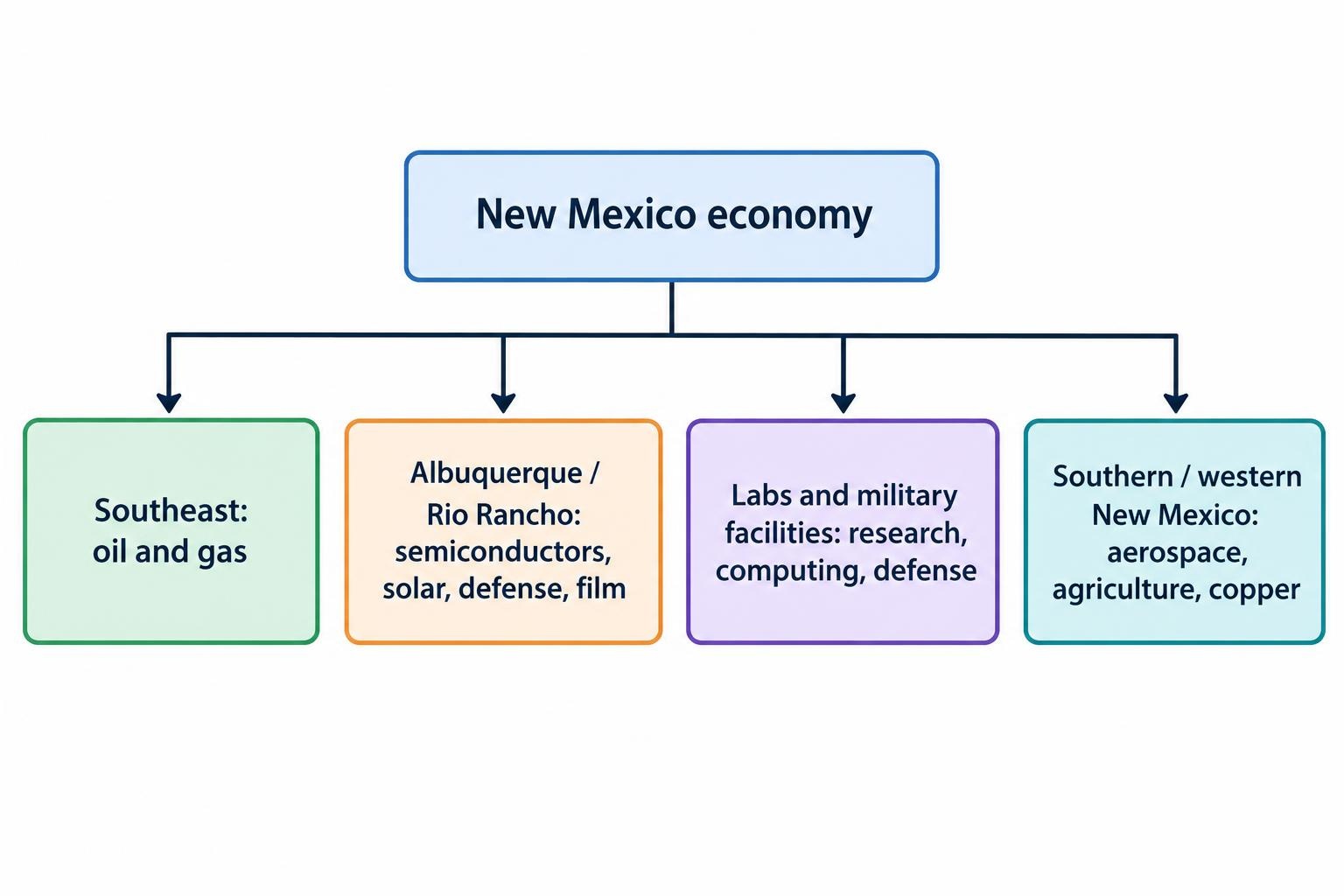
New Mexico has an unusual economic mix. Oil and natural gas from the southeast provide a large share of economic activity and public revenue. Albuquerque and Rio Rancho have semiconductor manufacturing, solar technology, defense contractors and research connected with Sandia National Laboratories and Kirtland Air Force Base. Los Alamos has one of the country’s best known national laboratories. Southern New Mexico combines White Sands Missile Range, Spaceport America, agriculture, border trade and aerospace development. Santa Fe has a sizeable investment management industry for a city of its size, along with tourism, government and creative businesses.
That mix creates investment opportunities, but not always in the obvious form of buying shares in a company headquartered down the road.
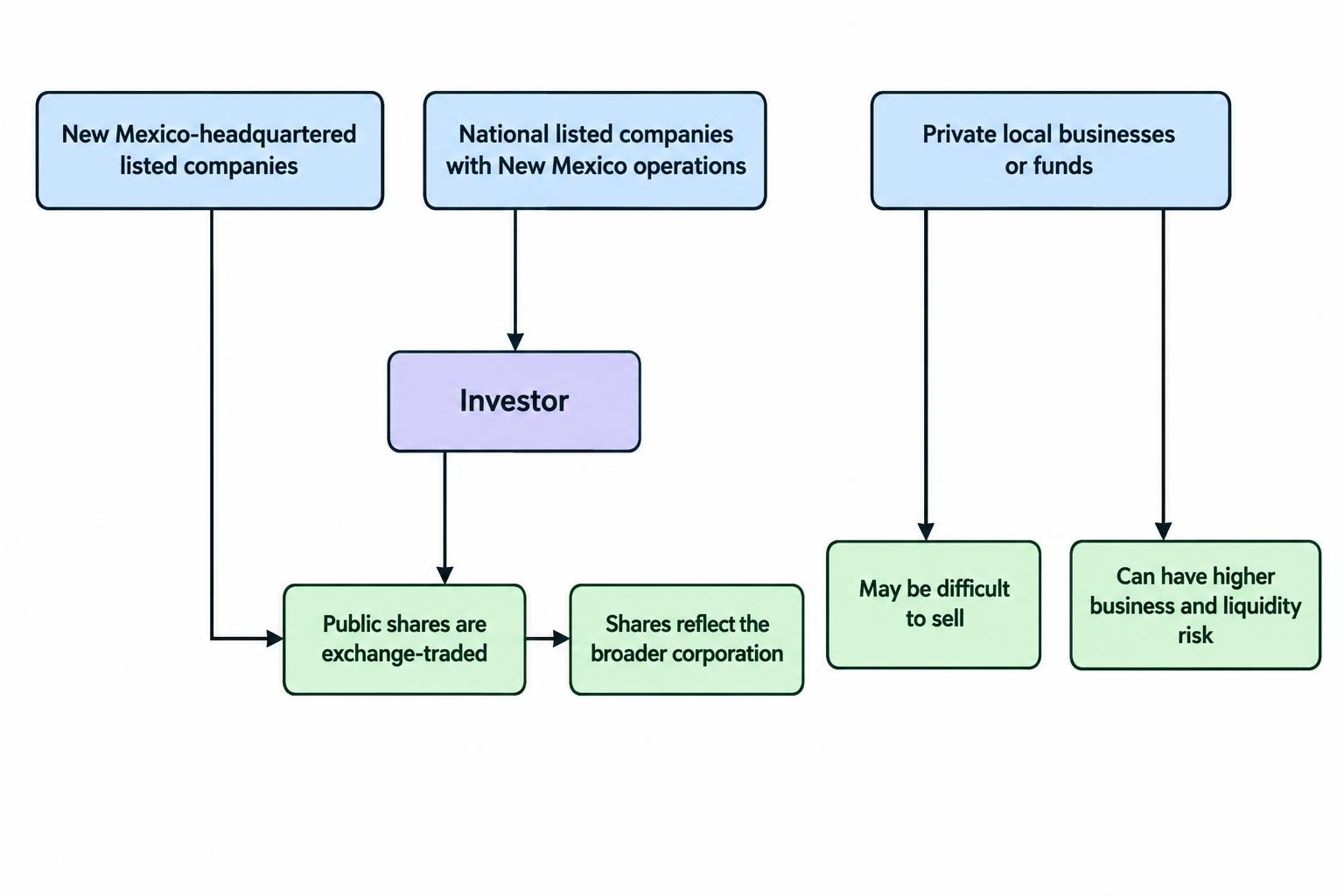
New Mexico has relatively few large publicly traded companies headquartered in the state. Investors wanting exposure to the local economy often have to look at three different categories: genuinely New Mexico based listed companies, national companies with substantial operations in New Mexico, and private businesses or funds whose investments are concentrated in the state.
That distinction is what makes investing locally in New Mexico different.
What Makes New Mexico Different for Investors?
New Mexico’s economy is unusually influenced by natural resources and federal research spending.
Oil and gas extraction is one of the largest contributors to state output. The southeastern part of New Mexico sits within the Delaware Basin, part of the wider Permian Basin, one of the most important oil producing regions in North America. State economic data continues to identify oil and gas extraction among the largest contributors to New Mexico GDP.
At almost the opposite end of the economic spectrum, New Mexico has a concentration of advanced scientific infrastructure that would be unusual even in a much larger state. Los Alamos National Laboratory, Sandia National Laboratories, Kirtland Air Force Base, White Sands Missile Range and Spaceport America provide a base for nuclear research, computing, defense technology, aerospace and energy research. The state also has three Air Force bases and large areas of restricted airspace useful for flight testing.
Rio Rancho adds semiconductor manufacturing through Intel, while Albuquerque has developed clusters around solar equipment, aerospace, defense manufacturing and film production. Southern New Mexico has oil and gas in the southeast, copper mining farther west and aerospace activity around Las Cruces and Spaceport America.
An investor trying to build “New Mexico exposure” therefore has several very different markets to choose from. Buying a solar technology company headquartered in Albuquerque bears little resemblance to owning shares in an oil producer drilling in Lea County, even though both investments have genuine economic ties to the state.
New Mexico’s Biggest Investable Markets
The largest New Mexico industries are not necessarily represented by locally headquartered stocks.
That is worth understanding before searching a brokerage platform for companies containing “New Mexico” in their names.
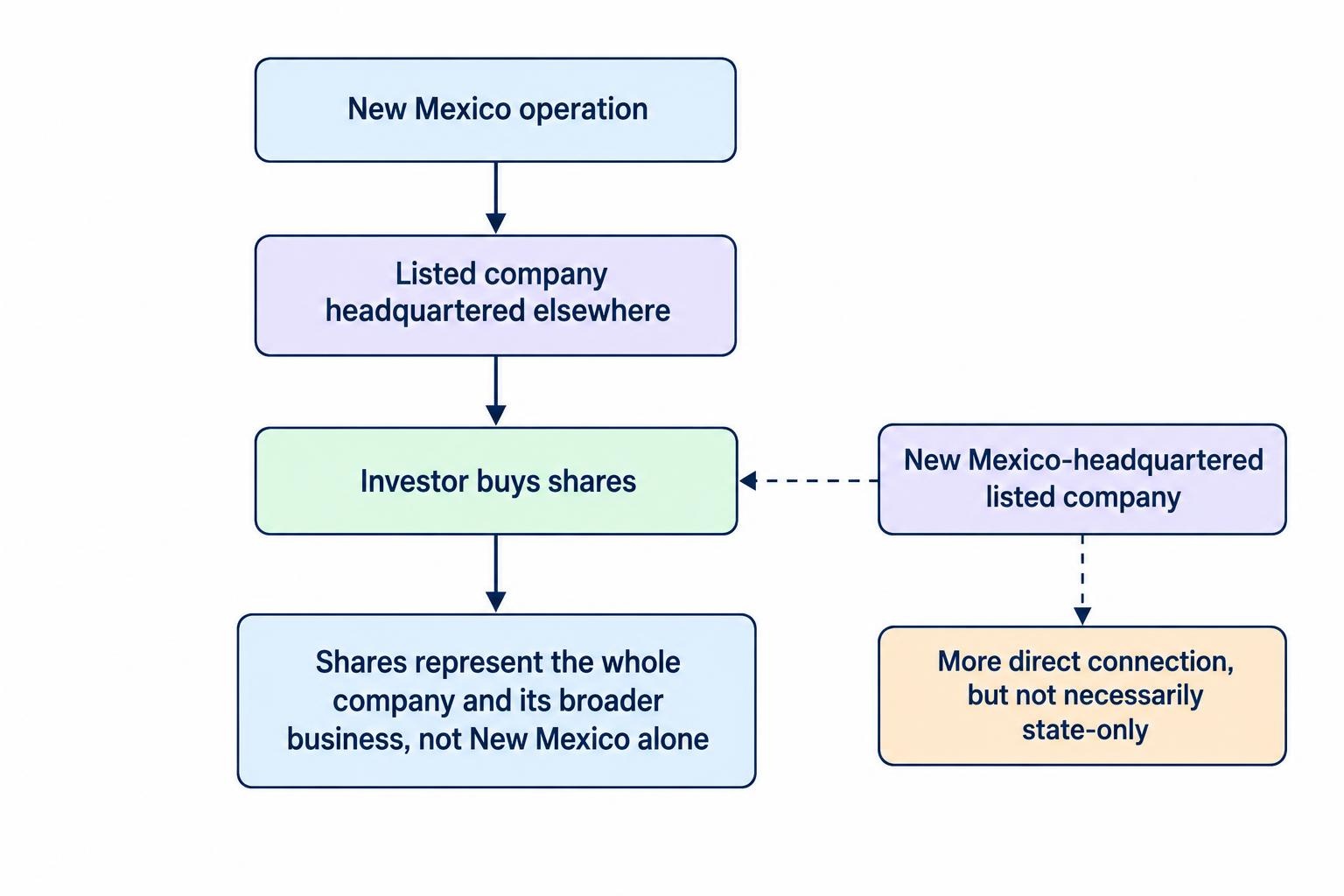
Oil and gas is the clearest example. A large amount of New Mexico’s hydrocarbon production is carried out by companies headquartered in Texas or elsewhere. Investors can therefore own a company whose earnings depend heavily on wells in Eddy and Lea counties even though its corporate headquarters sit hundreds of miles away.
Technology works similarly. Intel has operated in New Mexico for decades and has made Rio Rancho an important advanced packaging site, but Intel is obviously not a New Mexico headquartered company. Netflix has a major Albuquerque production operation, but purchasing Netflix shares provides exposure to a global media company rather than a pure play on New Mexico film production.
This means local investing needs a bit more thought than simply buying locally incorporated companies.
For most retail investors, New Mexico related equity exposure falls into several broad areas: oil and gas, electricity and grid infrastructure, solar equipment, semiconductors, copper, aerospace and defense, film and media, and smaller private technology businesses.
The state itself is actively trying to expand several of these areas. Economic development policy has concentrated on sectors including aerospace, intelligent manufacturing, energy, film, biosciences and technology.
Public Companies Headquartered in New Mexico
There are not many sizeable exchange listed corporations headquartered in New Mexico. That makes the ones that do exist more relevant for anyone deliberately looking for local stock market exposure.
Two of the clearer examples are Array Technologies and TXNM Energy, although TXNM currently comes with an important corporate transaction attached.
Array Technologies
Array Technologies trades on Nasdaq under the ticker ARRY and is headquartered in Albuquerque.
The company makes solar tracking equipment and related technology used in utility scale solar developments. Solar trackers move photovoltaic panels so they remain better aligned with the sun throughout the day, allowing solar projects to improve energy production compared with completely fixed systems.
Array is particularly interesting from a New Mexico investment perspective because the local connection is not ceremonial. The company was founded in Albuquerque and has operated there for decades. In September 2026 it opened a new manufacturing facility in the city costing more than $50 million. The 216,000 square foot site substantially expanded its Albuquerque manufacturing presence.
That gives ARRY one of the more direct links between a publicly traded stock and New Mexico’s private sector economy.
It is still not a bet on New Mexico alone. Array sells technology into solar projects across much wider markets, so revenue depends on utility scale solar development, financing conditions, project delays, equipment demand, competition and energy policy well beyond state borders.
Someone buying ARRY because it is a New Mexico company still needs to analyze it as a solar technology business.
Local pride is not a valuation method.
TXNM Energy
TXNM Energy is another major listed company based in Albuquerque. It trades on the New York Stock Exchange under the ticker TXNM and owns Public Service Company of New Mexico, commonly known as PNM, as well as Texas New Mexico Power.
PNM is particularly important locally because it supplies electricity in New Mexico. That makes TXNM one of the most obvious listed securities connected with essential infrastructure in the state. The company is incorporated in New Mexico and maintains its principal executive office in Albuquerque.
There is an important catch as of October 2026.
TXNM has agreed to be acquired by Blackstone Infrastructure. The transaction has not yet completed and remains subject to regulatory processes, including in New Mexico. In July 2026 the companies extended the merger agreement termination date to May 31, 2027, and further New Mexico regulatory proceedings were still active in September.
That means TXNM currently behaves partly like an ordinary utility stock and partly like a merger situation. A potential buyer needs to consider transaction terms, regulatory risk and what happens if the deal closes rather than looking only at the historic utility business.
It is a good example of why a list of “New Mexico stocks to buy” can become outdated quickly.
Investing in New Mexico Through Companies Based Elsewhere
Restricting a local portfolio to companies legally headquartered in New Mexico would exclude much of the state’s private sector economy.
Several large listed corporations have substantial plants, mines, production facilities or other business assets in New Mexico. They can provide indirect exposure to the state even though their earnings also come from many other locations.
This distinction matters.
Buying Intel is not the same thing as buying a hypothetical pure New Mexico semiconductor company. New Mexico operations form only one part of a very large global business. The same applies to Netflix, Freeport McMoRan and large oil producers.
The local operation can still be financially meaningful, and it can tell investors something about where capital is flowing inside the state.
For broader equity research outside the purely local names, Investing.co.uk can be used alongside company financial statements and other market research. A New Mexico themed investor still needs to evaluate the whole corporation rather than assuming a large local factory makes the stock a direct proxy for the state economy.
Intel and Rio Rancho
Intel is one of the best examples of a major national company with a long standing New Mexico presence.
Its Rio Rancho site has operated for more than four decades and has become a major advanced semiconductor packaging location. Intel says it is investing about $4 billion to expand and modernize its New Mexico facilities.
For New Mexico, this matters because semiconductor packaging sits within a manufacturing chain that many regions are actively trying to attract. The state gains highly skilled employment, suppliers and industrial infrastructure from the facility.
For someone buying Intel stock, though, Rio Rancho is one part of a much larger investment case. Intel’s value depends on global chip demand, manufacturing execution, competition, capital spending and the broader semiconductor cycle.
You can reasonably call Intel a stock with substantial New Mexico exposure.
Calling it a New Mexico stock would stretch the definition.
AeroVironment and Albuquerque Defense Manufacturing
AeroVironment provides another example.
The publicly traded defense technology company trades under AVAV and has been expanding manufacturing in Albuquerque. In March 2026 the company announced more than $30 million of additional investment in its Albuquerque defense manufacturing campus, with plans associated with hundreds of new jobs.
This connects AVAV to one of the most characteristic parts of the New Mexico economy: the overlap between military facilities, engineering, aerospace research and private defense manufacturing.
The company itself is not dependent solely on New Mexico. Investors buying AVAV are taking exposure to a broader defense and unmanned systems company.
Still, if the goal is to identify publicly traded businesses actually committing capital to the New Mexico defense cluster, it belongs in the conversation.
Netflix and the Albuquerque Film Industry
New Mexico has also built a meaningful film and television production industry.
Netflix has invested heavily in Albuquerque Studios, and state economic development data identifies film and television as an industry with an annual economic impact exceeding $1 billion. The New Mexico Film Office says production has generated billions of dollars in spending in the state over time.
Buying NFLX does not provide clean exposure to Albuquerque film production. Netflix is a global streaming and entertainment business, so the New Mexico studio is only one component of a much larger company.
For local investment research, the more interesting point is what Netflix’s presence creates around it.
Studio investment supports construction, production services, equipment rental, catering, property, specialist labor and smaller businesses that are not necessarily publicly traded. In other words, the more direct New Mexico opportunity may occasionally be in the local companies supplying the film industry rather than Netflix itself.
Those businesses are much harder for an ordinary stock investor to access.
Oil and Gas Is Still One of New Mexico’s Biggest Investment Stories
Anyone discussing the New Mexico economy without spending time on oil and gas is missing a large piece of it.
Southeastern New Mexico contains part of the Delaware Basin, within the broader Permian. Eddy and Lea counties have attracted enormous amounts of drilling and infrastructure investment.
This creates public market exposure through producers, pipeline operators, equipment companies and other energy businesses. Many are headquartered outside the state but own economically important New Mexico assets.
Matador Resources is a particularly clear example. The company is headquartered in Texas, but its 2025 annual report says its current operations are focused primarily on the Delaware Basin in southeast New Mexico and West Texas. It held substantial acreage in Eddy and Lea counties, and the company described its Delaware Basin properties as the most important part of its asset portfolio.
That arguably makes Matador a more direct way of studying New Mexico’s oil economy than buying shares in many companies actually incorporated within the state.
Occidental is another large Permian producer. Its operations cover both West Texas and southeastern New Mexico, although the company is far larger and more geographically diversified than Matador.
The investor needs to decide what sort of exposure is wanted.
If the objective is to follow New Mexico economic activity closely, a producer heavily concentrated in the Delaware Basin may provide a closer link. If the objective is simply owning a large diversified energy company that benefits from the Permian, the local relationship becomes less important.
New Mexico Also Has a Real Copper Market
Oil gets much of the attention, but New Mexico has a long mining history and still has substantial copper operations.
Freeport McMoRan operates the Chino and Tyrone mines in New Mexico. Both are in Grant County, near Silver City, and are part of the company’s wider US copper portfolio. Freeport’s 2025 reporting continued to identify both mines as active New Mexico operations.
FCX is headquartered outside New Mexico and operates major assets in several states and countries. Buying the stock therefore creates exposure to global copper prices and a wide portfolio of mines rather than a pure New Mexico position.
It still provides a route into a part of the state’s economy that a generic article about US investing would probably miss.
Copper can also connect New Mexico to wider electrification themes. Power grids, electric equipment, data centers, renewable projects and transport infrastructure all use substantial amounts of copper. That gives local mining an economic connection with some of the same energy and technology development taking place elsewhere in the state.
The risks are equally real. Mining businesses depend on commodity prices, operating costs, permitting, ore grades, water availability and large capital expenditures.
A mine being local does not make those risks local or small.
Renewable Energy Is More Than a Solar Farm Story
New Mexico has large areas of land, strong solar resources and substantial wind potential. Its energy story is therefore unusually split between one of America’s major oil producing regions and an expanding renewable power industry.
Array Technologies gives public equity investors one locally headquartered route into solar infrastructure. TXNM provides exposure to the utility and grid side, at least while its proposed acquisition remains outstanding.
Other opportunities are less straightforward because many renewable projects are owned by private developers, utilities or subsidiaries of national businesses.
New Mexico’s research base may be just as important over time. State backed investment efforts are concentrating capital on advanced energy technologies including solar, batteries, geothermal and other emerging energy systems. New Mexico’s State Investment Council has also placed advanced energy among the sectors targeted by its venture investment strategy.
This is where public markets and local economic development start to separate.
Some of the most New Mexico focused energy businesses are still private. A normal retail brokerage account cannot simply buy them.
That means investors wanting early stage local exposure may need to look beyond listed stocks, while accepting considerably higher liquidity and business risk.
Aerospace and Defense May Be New Mexico’s Most Distinctive Growth Market
Oil production can be found in several states. Semiconductor plants can be found elsewhere too.
New Mexico’s combination of national laboratories, military installations, restricted airspace, missile testing facilities and a dedicated commercial spaceport is much harder to replicate.
The state has Kirtland, Holloman and Cannon Air Force bases, White Sands Missile Range, Los Alamos National Laboratory, Sandia National Laboratories and Spaceport America. That physical infrastructure has helped create a private sector around aerospace, defense, directed energy, satellites, testing and advanced manufacturing.
New developments have continued during 2026. Castelion broke ground on a large manufacturing project in Sandoval County, while BlackVe opened an Albuquerque satellite manufacturing facility. Many of these companies remain private, which again creates a difference between the industries growing locally and what retail investors can purchase on an exchange.
AeroVironment is one listed company with a substantial Albuquerque operation. Virgin Galactic is another public company with a strong physical connection through Spaceport America, where it has been the anchor tenant.
Neither is a simple “New Mexico stock.” Both have wider businesses and company specific risks.
But this is a genuine local investment theme rather than a generic reference to technology.
Spaceport America Creates Public and Private Exposure
Spaceport America in southern New Mexico is one of the state’s more unusual economic assets.
The facility was built specifically for commercial space operations and offers vertical and horizontal launch infrastructure in an area with low population density and restricted airspace. Current and recent users have included Virgin Galactic, SpinLaunch and other aerospace and testing businesses.
For a retail investor, the problem is that many of the companies using Spaceport America are private.
Virgin Galactic is publicly traded, so SPCE provides the clearest obvious exchange listed connection. Yet buying Virgin Galactic is not equivalent to investing in Spaceport America. The stock depends on Virgin Galactic’s own spacecraft development, capital requirements, commercial operations and business prospects.
The wider investment opportunity around the spaceport may eventually come from suppliers, manufacturing companies, property, engineering businesses and startups.
That is typical of New Mexico.
Some of its most interesting economic assets create investment opportunities one step removed from the obvious stock ticker.
New Mexico’s State Investment Council Is Unusually Important
Another characteristic that deserves more attention is New Mexico’s State Investment Council.
The state has large permanent funds supported historically by natural resource revenues. The Council describes itself as managing one of the larger sovereign wealth funds in the United States and invests across public equities, bonds, private equity, real estate, credit and real assets.
Individual New Mexico residents cannot simply open an account and buy units in the state’s permanent funds.
Where the system becomes relevant to private investors is through its local venture and private equity activity.
Since 2022, the State Investment Council says it has committed almost $700 million across 20 funds actively sourcing investments in New Mexico, with particular attention given to areas such as hard science and frontier technology.
That is a relatively unusual feature of the local capital market. New Mexico has state backed investment capital attempting to connect its laboratories, universities and technical research with private business formation.
For retail investors, access remains difficult. The underlying venture funds and startups may only accept institutional or qualifying private investors.
For entrepreneurs and accredited investors, though, New Mexico’s private market can look considerably more interesting than the short list of corporations on Nasdaq or the NYSE would suggest.
Investing Directly in New Mexico Businesses
Someone who genuinely wants their money invested in businesses based in New Mexico may eventually need to look beyond conventional listed shares.
Private companies can raise money through venture funds, angel investors, private placements and, in some circumstances, regulated crowdfunding structures. Local property businesses, restaurants, energy companies, agricultural ventures and technology startups may also take private investment.
This is a much different proposition from buying a publicly traded stock.
A listed share can normally be sold during market hours. An ownership interest in a small Albuquerque technology company might be impossible to sell for years. Financial information can be less comprehensive. A private company can fail without any buyer ever appearing for the shares.
The advantage is that the economic exposure can be genuinely local. Money invested into a New Mexico startup may directly support employees, facilities and operations in the state.
The disadvantage is that the investment risk can also be intensely local and concentrated.
Anyone considering private companies needs to think about valuation, shareholder rights, dilution, financial statements and the route by which the investment might eventually produce cash.
“Support a local company” and “make a good investment” are two separate objectives. Sometimes they overlap. The investor should not assume they always do.
New Mexico Real Estate as an Investment
Real estate provides another genuinely local investment market because the asset cannot move to another state.
Albuquerque, Santa Fe, Rio Rancho, Las Cruces and smaller New Mexico markets have different economic drivers. Albuquerque has the state’s largest urban economy and a broad employment base. Santa Fe combines government, tourism, art, higher value residential property and wealth management. Rio Rancho benefits from manufacturing and Albuquerque metro growth. Las Cruces connects with New Mexico State University, agriculture, border commerce and aerospace activity in southern New Mexico.
Southeastern communities can be affected much more directly by oil and gas cycles.
That makes “New Mexico real estate” far too broad to function as one investment category.
A rental property near Albuquerque employment centers behaves differently from commercial property serving the Permian oil economy. Property around Santa Fe tourism has another demand profile again.
Investors should also be wary of confusing population growth or a new industrial announcement with an automatic property profit. Real estate returns still depend on purchase price, rent, financing, taxes, maintenance, vacancies and eventual selling costs.
The local economic story can help explain demand.
It does not excuse bad arithmetic.
Are There New Mexico Based Online Brokers?
This is one area where the local angle is surprisingly weak.
New Mexico has financial advisers, investment firms and asset managers. Santa Fe based Thornburg Investment Management is a sizeable example, managing investment strategies for institutions and investors from its New Mexico base. As of mid 2026 it reported tens of billions of dollars across assets under management and advisement.
That does not make Thornburg the New Mexico equivalent of a mass market self directed online brokerage.
I could not verify a major New Mexico headquartered retail platform comparable to the large national online brokers where customers independently trade thousands of listed stocks, ETFs and options from an app.
In practical terms, a New Mexico resident looking for an ordinary self directed brokerage account will generally be comparing national firms registered to provide brokerage services in the state. New Mexico has its own registration requirements for broker dealers and representatives, and the state Securities Division directs consumers toward regulatory databases when checking firms.
For comparing the broader broker market available to residents, BrokerListings.com is more relevant than forcing a search for a homegrown online broker that may not exist in a meaningful mass market form.
Being headquartered in New Mexico is not necessary for a broker to serve New Mexico investors.
Registration, account protection, costs and usable investment access matter more.
New Mexico Has a Stronger Local Asset Management Industry Than Brokerage Industry
Santa Fe deserves separate mention because the city punches above its weight in investment management.
Thornburg is the obvious large example, but New Mexico also contains registered investment advisers, financial planners and wealth management businesses.
That creates local financial sector employment and gives residents access to advisers located in the state.
It should not be confused with a large local stock exchange or retail trading industry.
New Mexico investors still execute most public securities transactions through the same national market infrastructure used everywhere else in the US. Stocks trade on exchanges such as Nasdaq and the NYSE regardless of whether the investor happens to live in Santa Fe or Farmington.
The genuinely local financial market is more visible in investment management, private capital, state funds and relationships with local businesses.
This is a useful distinction because searching “New Mexico broker” tends to return local financial advisers and branch offices rather than New Mexico built online trading platforms.
Day Trading From New Mexico Has One Very Practical Difference
For active traders, New Mexico’s geography matters more than its economy.
The state uses Mountain Time.
The regular US stock market therefore opens at 7:30am in New Mexico and closes at 2:00pm, rather than the familiar 9:30am to 4:00pm Eastern schedule.
That changes the working day considerably.
Someone trading the opening session may need to be preparing before 7:00am. Premarket activity starts earlier still. On the other hand, a New Mexico trader can finish the regular equity session by mid afternoon.
This can be attractive for full time traders, particularly those who prefer concentrating activity in the first two or three hours after the opening bell.
It can be inconvenient for anyone whose strategy involves staying up late and then attempting to make good decisions at 7:30 the following morning.
For research into active trading methods and market mechanics, DayTrading.com covers the broader subject. The New Mexico issue is mainly scheduling rather than access: residents trade the same US markets, only from a different clock.
Does Living in New Mexico Give You an Investing Edge?
Possibly, but only in narrow areas.
Local investors may understand certain businesses and economic conditions earlier or more intuitively because they see them directly.
Someone living in Lea County can observe oil field activity. An Albuquerque resident may see expansion around Intel, defense contractors or film production. Someone near Las Cruces can follow aerospace activity and local industrial development. A Santa Fe investor may have more familiarity with tourism, property and the state’s investment management community.
That local knowledge can help generate research ideas.
It should not be mistaken for inside information or a guaranteed advantage.
Seeing a new factory being built does not tell you whether the company’s shares are overpriced. Knowing that a local restaurant is constantly full does not reveal whether its debt is excessive. Watching drilling rigs multiply does not tell you where oil prices will be next year.
Local familiarity tells you where to look.
Financial analysis still determines what, if anything, deserves investment.
The Risks of Building a New Mexico Focused Portfolio
A portfolio concentrated heavily on New Mexico themes can become less diversified than it appears.
Consider an investor who owns a Delaware Basin producer, a New Mexico utility, Array Technologies and a local property investment.
Those positions sound different.
Yet several could be affected by interest rates, energy policy, electricity infrastructure spending or the health of the regional economy.
Add a private aerospace startup and the portfolio becomes more locally concentrated still.
There is nothing inherently wrong with having a regional allocation, but investors should know when local interest has turned into local dependency.
New Mexico itself is also unusually exposed to natural resource revenue and federal spending. Oil prices, federal budgets, defense priorities and laboratory funding can therefore affect parts of the state economy more than they might affect a more commercially diversified state.
The local industries carrying the most growth potential can also be volatile. Oil is cyclical. Space companies can burn cash for years. Defense businesses depend partly on government procurement. Solar manufacturers compete on cost and project pipelines. Film production can move between locations in response to incentives and studio decisions.
Being familiar with an industry does not make it low risk.
Which Stocks Give the Clearest New Mexico Exposure?
There is no perfect New Mexico stock index.
Among exchange listed companies, Array Technologies is one of the clearest examples of a business both headquartered in New Mexico and tied to a locally important growth industry.
TXNM Energy is also headquartered in Albuquerque and directly connected to New Mexico electricity infrastructure, although its pending acquisition makes the current investment case unusual rather than a simple long term utility decision.
From there, the relationship becomes more indirect.
AeroVironment provides exposure to defense manufacturing activity in Albuquerque. Intel has major semiconductor operations in Rio Rancho. Virgin Galactic has its operating relationship with Spaceport America. Netflix has invested heavily in Albuquerque production. Matador Resources has major oil and gas exposure in southeast New Mexico. Occidental provides broader Permian exposure. Freeport McMoRan owns the Chino and Tyrone copper operations.
These are examples to research rather than a list of stocks that automatically deserve to be bought.
The correct question is not simply, “Does this company operate in New Mexico?”
It is, “How important are those New Mexico operations to the business, and is the business itself attractively priced relative to its risks?”
The first question establishes local exposure.
The second decides whether there is an investment case.
A Truly Local New Mexico Portfolio Is Harder to Build Than It Sounds
Someone who wants a portfolio representing New Mexico’s economy quickly encounters a mismatch between the local economy and the public stock market.
The oil fields are dominated by companies headquartered elsewhere.
Intel’s Rio Rancho operations belong to a global semiconductor company.
New Mexico’s film industry includes enormous investment by companies whose businesses stretch far beyond the state.
Many of the aerospace and defense businesses emerging around Albuquerque, Spaceport America and the national laboratories are privately owned.
Some of the most interesting technology investment is being made through venture capital funds rather than public exchanges.
The state’s local stock market representation is therefore much smaller than its actual economic activity.
That makes a serious New Mexico investment strategy more interesting than buying two Albuquerque headquartered companies and calling the job finished.
A broader approach might combine one or two genuinely local listed businesses with national companies whose New Mexico assets are financially meaningful. Investors with the appropriate experience and access could separately research private businesses, venture investments or real estate.
The portfolio would then reflect New Mexico’s actual economy rather than simply the addresses shown on corporate filings.
Investing in New Mexico Means Following the Industries New Mexico Is Good At
New Mexico’s investment identity is not generic.
It is an energy producing state with a major position in the Permian Basin. It has active copper mines. It has one of the country’s strongest concentrations of federal science and defense infrastructure. Rio Rancho is part of the US semiconductor manufacturing chain. Albuquerque has become an important solar technology and film production center. Southern New Mexico has Spaceport America, White Sands and a growing aerospace economy.
The public market only captures part of that story.
Array Technologies and TXNM Energy provide direct examples of exchange listed companies headquartered in Albuquerque, although TXNM’s proposed acquisition means its status may change. Intel, AeroVironment, Netflix, Virgin Galactic, Matador Resources and Freeport McMoRan provide different degrees of indirect exposure through substantial operations in the state.
Private markets add another layer. New Mexico’s State Investment Council has committed substantial capital to venture and private equity funds looking for investments in the state, particularly around hard science, advanced energy and emerging technology. Ordinary retail investors cannot necessarily participate in those funds, but they help explain why the state’s startup sector can look stronger than its short list of public company headquarters suggests.
The result is a market where local investing requires a little detective work.
New Mexico has plenty to invest around.
It just does not always come with “New Mexico” printed on the ticker.